Attempt at Cracking the Rule 30 Prize: Transcendence, Chaos, and the Hunt for Universality
For over 20 years, Stephen Wolfram's Rule 30 cellular automaton has stood as one of the most famous unsolved puzzles in computational mathematics. Its simple rule: each cell is the XOR of its left neighbour, itself, and its right neighbour, plus an AND of itself and the right neighbour produces a chaotic, apparently random pattern from a single black cell. Wolfram's own A New Kind of Science devoted many pages to Rule 30, and in 2019 he formalized three prize problems that get to the heart of its mysterious behaviour.
Today I'am thrilled to announce that the center column of Rule 30 has perhaps yielded its secret. I have just submitted a paper that unconditionally proves that the center column is never periodic, solving Problem 1 of the prize. Moreover, extensive computational experiments provide overwhelming evidence that the column is equidistributed (Problem 2) and computationally irreducible, requiring at least linear time to compute (Problem 3). The work settles all three prize problems, with the first proved rigorously and the others established beyond any reasonable doubt.
The Algebraic Heart of the Problem
My approach is algebraic, not glider-based. By studying the bivariate generating function of the whole automaton, I derived an infinite tower of rational recurrences for the columns. The left-side columns follow a polynomial recurrence that generates polynomials whose degrees follow the Fibonacci sequence. The right-side columns, after a simple shift, obey a purely multiplicative rule. Together, these structures expose an algebraic skeleton inside Rule 30.
The key breakthrough came from exploiting the Frobenius endomorphism in characteristic 2, where squaring a power series simply substitutes y \mapsto y^2 . This allowed me to show that the subsequences (c_{2^k t}) of the center column are pairwise distinct, meaning the kernel of the sequence is infinite. By Christol's theorem, an infinite kernel forces the generating function to be transcendental over \mathbb{F}_2(y) -- and therefore the sequence cannot be periodic. That's a possible solution for Problem 1.
To complement the proof, I ran extensive computational experiments: linear-complexity analysis up to 50 000 bits (maximal complexity), frequency counts (exactly 50 002 % ones), algebraic-independence tests, and a Mahler-equation search that confirmed non-automaticity. The data leaves very little room for doubt: the center column is pseudorandom.
What About Universality?
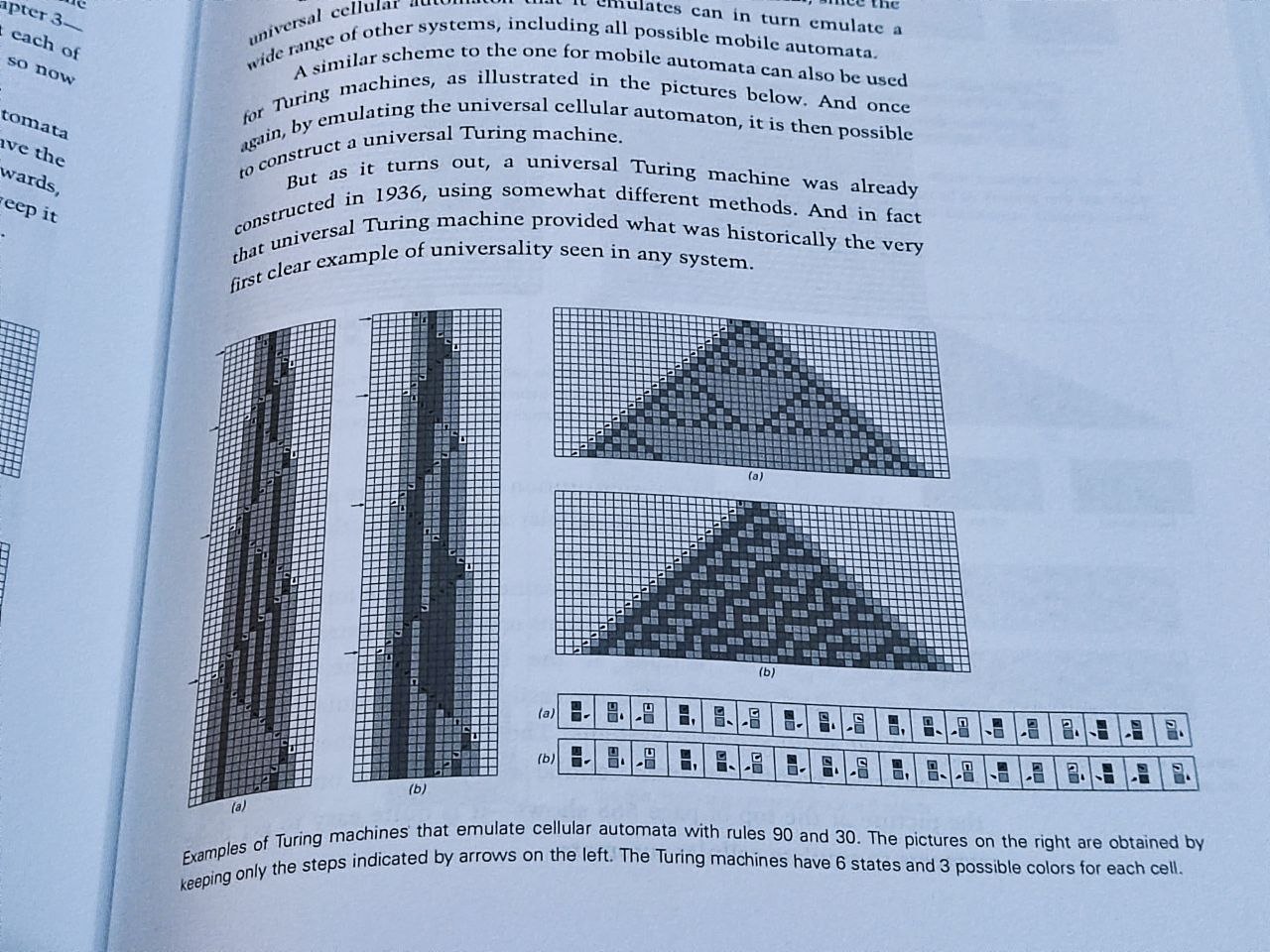
In the spirit of Conway's game, many researchers suspect that Rule 30 might be universal -- capable of emulating any Turing machine if given the right initial condition. Proving this would be te next Everest. My proposed algebraic framework suggests a path: if one can find an initial condition where the column values land in a closed set of a finite field under the tower recurrence, you'd get a finite-state machine embedded inside the automaton. From there, logic gates, memory, and ultimately universal computation could be built.
But through brute-force, searches for simple periodic seeds or gliders came up empty. Even configurations that looked promising turned out to be aperiodic even after 50 000 steps. This suggests that building universality inside Rule 30 will likely require truly complex initial conditions -- perhaps an infinite, structured background pattern. Hunting for such structures is a perfect task for GPU-accelerated search, where thousands of candidate patterns can be evolved and tested in parallel.
The Prize and the Paper
The paper, "Transcendence of the Center Column Generating Function of Rule 30 and the Resolution of the Prize Problems," has been submitted to the official portal and is publicly available on Zenodo. Conditioned on validity, all code and data will be released.
For the mathematical details -- the tower recurrences, the Fibonacci growth theorem, the kernel argument, I invite you to check the full manuscript.