[Notes] -- Preprint: In-Place Test-Time Training
A new milestone?
Introduction
This post is about the following preprint: In-Place Test-Time Training
However, this is not a "review" type of post. I don't really believe in those things -- though I will outline some points that I personally find interesting. My underlying rationale is that each of us is unique and, though having the summary/write-up by someone else helps; it conveys a personal perspective which through my numerous readings lead me to conclude that they are often too "flawed/biases" with respect to the original authors of any piece of work -- one can also see this as a game of minimizing/maximizing mutual information between one/other.
Maybe the best example to further outline my argument is through Precision/Personalized Medecine; the only interesting thing about generics are their democratic prices. This is where AI's potential can make things happen that were not possible before. On a conceptual and potential level this may echo something like: Personal SuperIntelligence
Core of the Matter
I write these few lines because I am concerned and work (among other things) by the whole AI Safety / Alignment thing. I called it thing because, we kind of feel what these are supposed to be without being able to articulate a proper/formal definition(s) about them.
Anyhow, in the great scheme of things, I believe we have hit a new milestone with this paper. What do I mean by that?
A number of persons have said it but I'll refer to Kai-Fu Lee saying something about the change in magnitude that AI can be the new electricity.
Breath in Breath Out
One of the main points developed in the paper is that the LLM ecosystems are ''fixed'' or static. This is a notion that I have been pondering upon since GPT-2. I believe this paper (and possibly others before?) paves the way to a new power dynamic. I like to think of it from switching to DC to AC. The idea came to my mind when seeing the following device: a mercury arc rectifier -- what matters are the concepts.
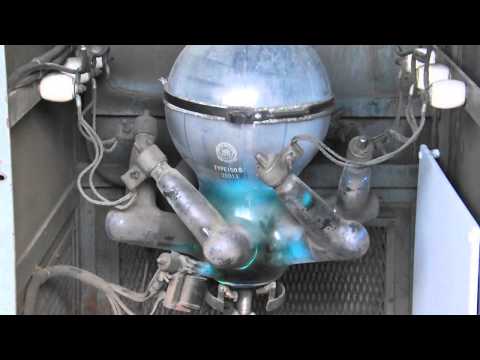
This new power dynamics which is dynamical in the sense that the authors propose to use one of the Transformer-neural architecture(TNA) component i.e. the last MLP blocks precisely for dealing with transient information/memory.
Another analogy would perhaps be from computer communication networks i.e. moving from simplex to half-duplex channel communications.?
It also interesting to note that this evolution in TNA follows the development of Large Language Reasoning models i.e. in a way to push forward their capabilities.
Some Technical Elements
The static aspect can roughly be described as follows: LLMs are trained on a substantial amount of data, they acquire consequential knowledge that we find it very useful and productive to interact with/use. This knowledge is mainly stored as weights, where reasoning may happen or/and through the use of Chain-Of-Thought. Though, I would like to draw the attention that the architecture mattersand has weight too.
Incidentally,
-
I believe the following reference for understanding multi-token prediction is interesting: Better & Faster Large Language Models via Multi-token Prediction
-
The notion of context parallelism described in the paper is of interest.
Conclusion
Please do note that I purposely don't get into the granularities and intricacies of what might or might not be going with the training of LLMs/LRMs. I started the project: Emergent Cognition to investigate this.
Finally, I would like to say that there may very well be prior work(s) on providing a way to ''unfreeze'' or render LLMs/LRMs more dynamic but I happen to came upon this one recently (and didn't perform a systematic review) and the timing feels right.
References
Vizuara AI Labs: Build DeepSeek from Scratch
Chain of Thought Monitorability: A New and Fragile Opportunity for AI Safety